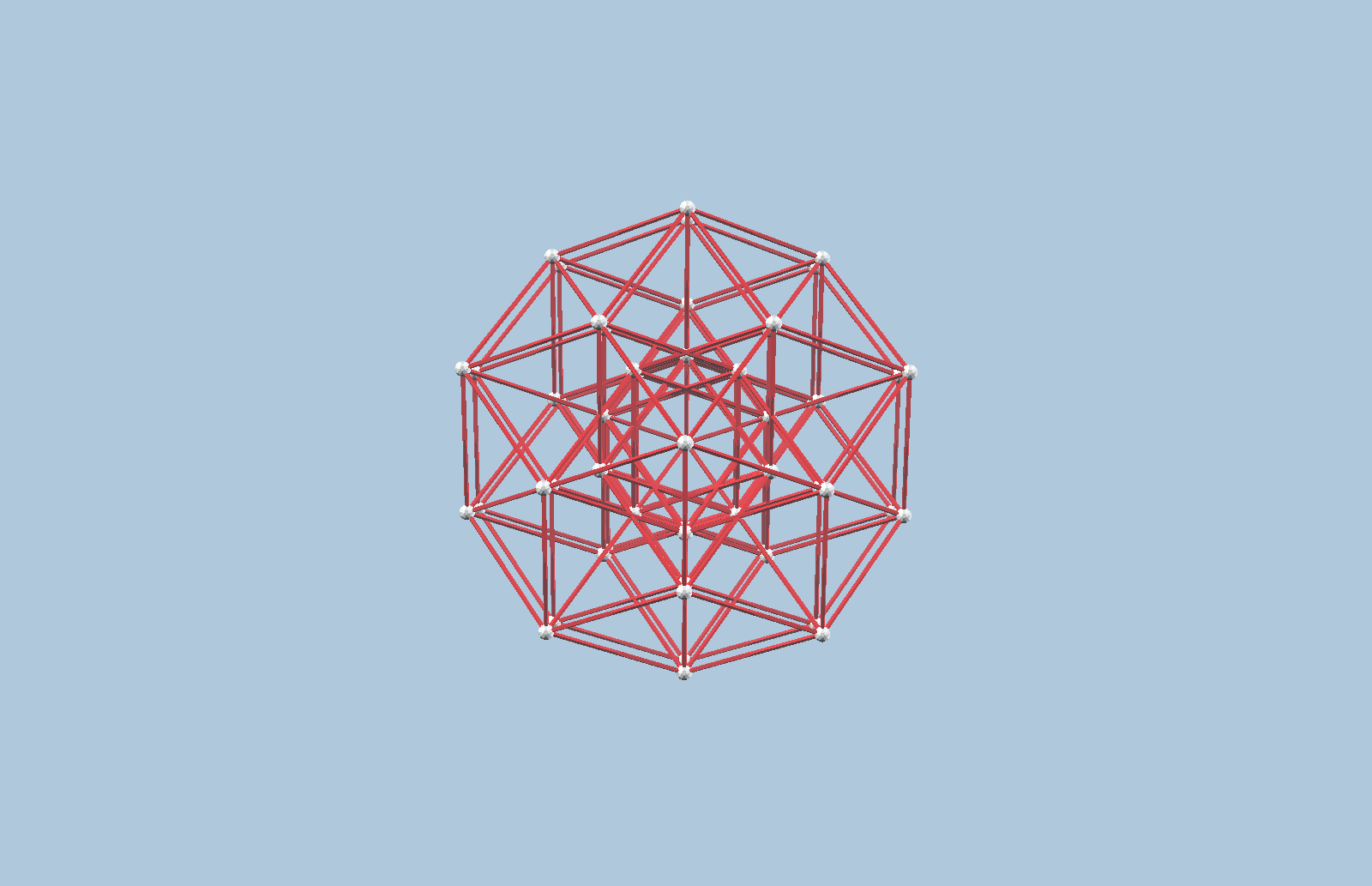
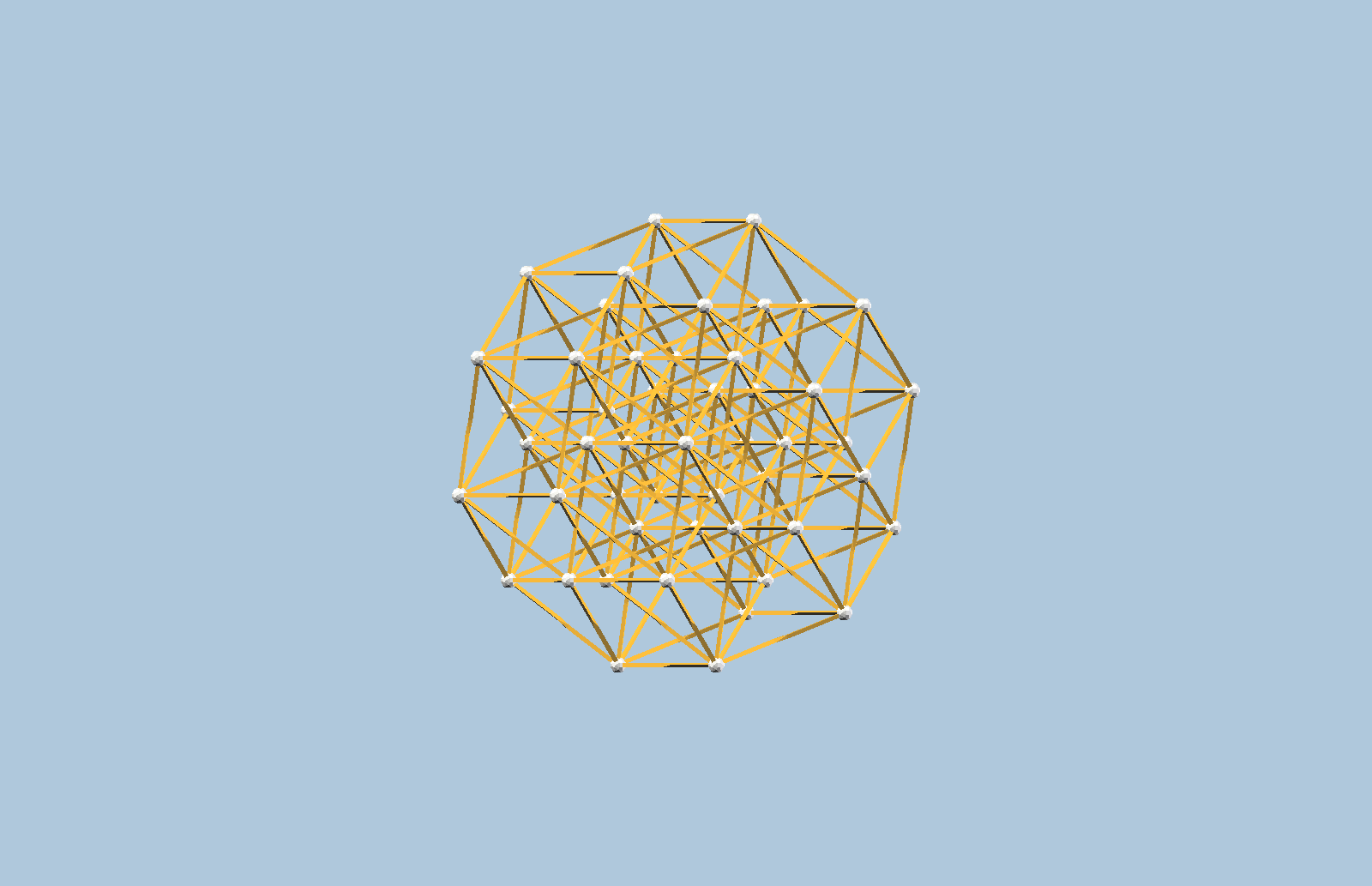
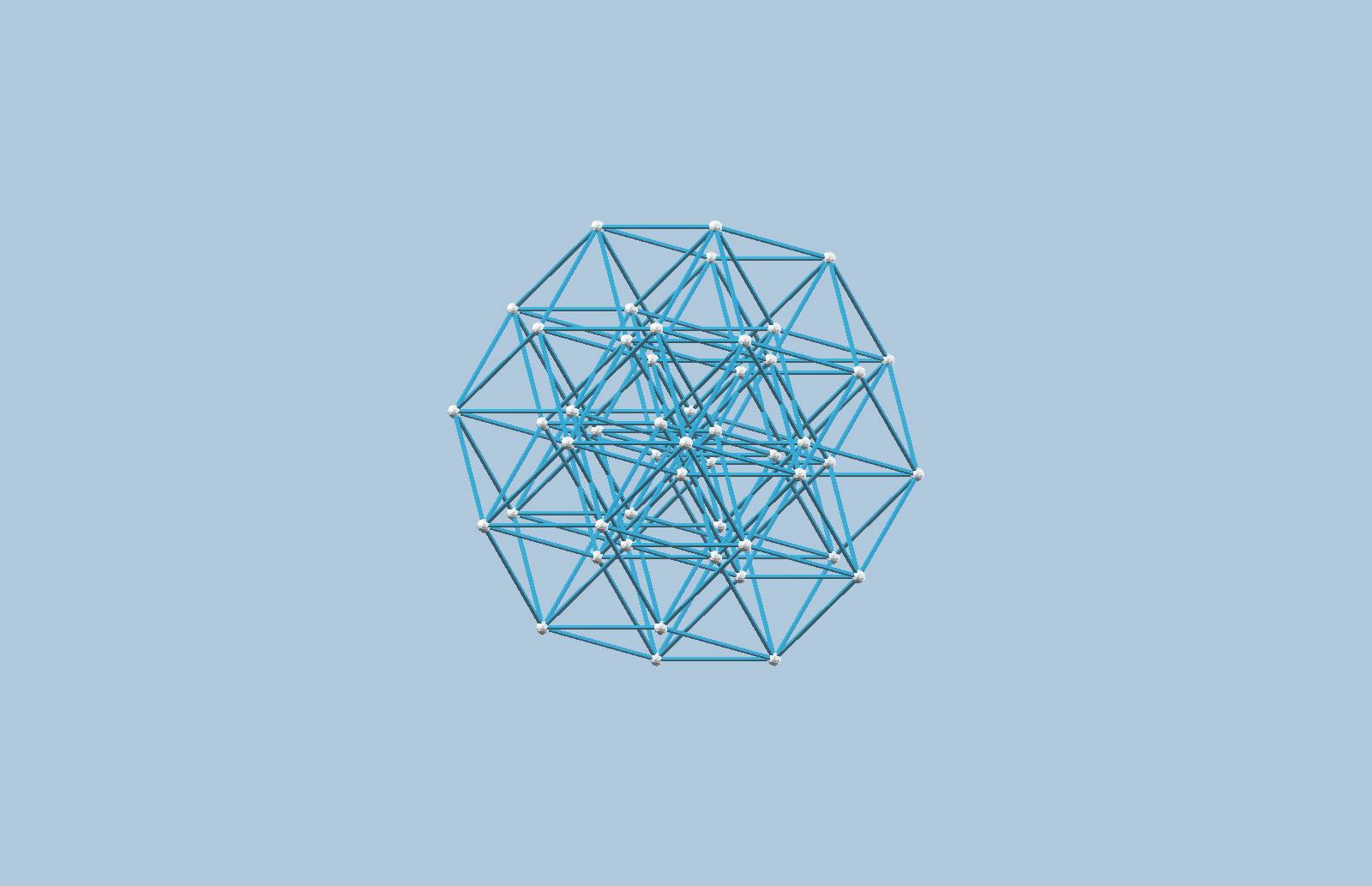
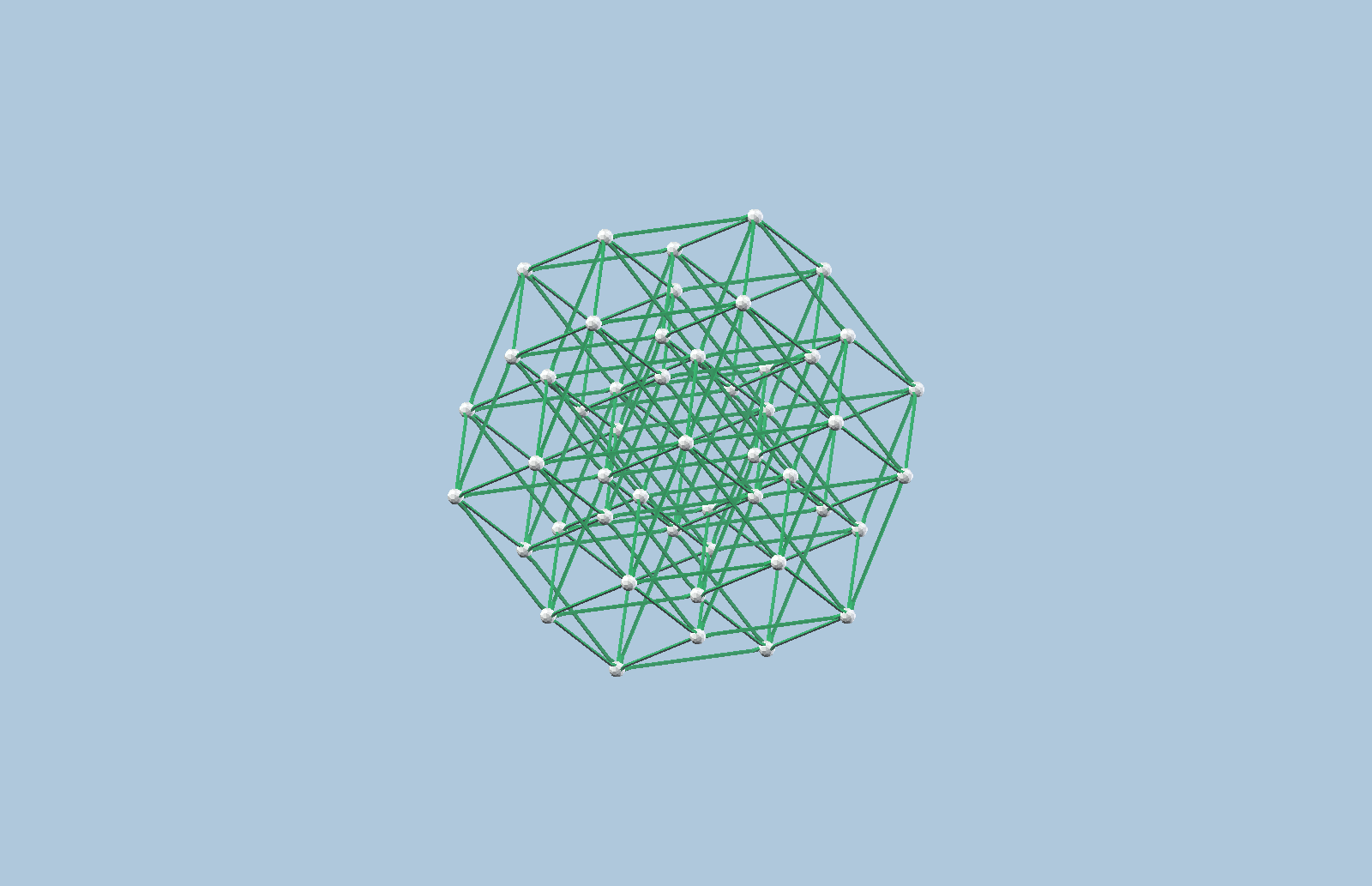
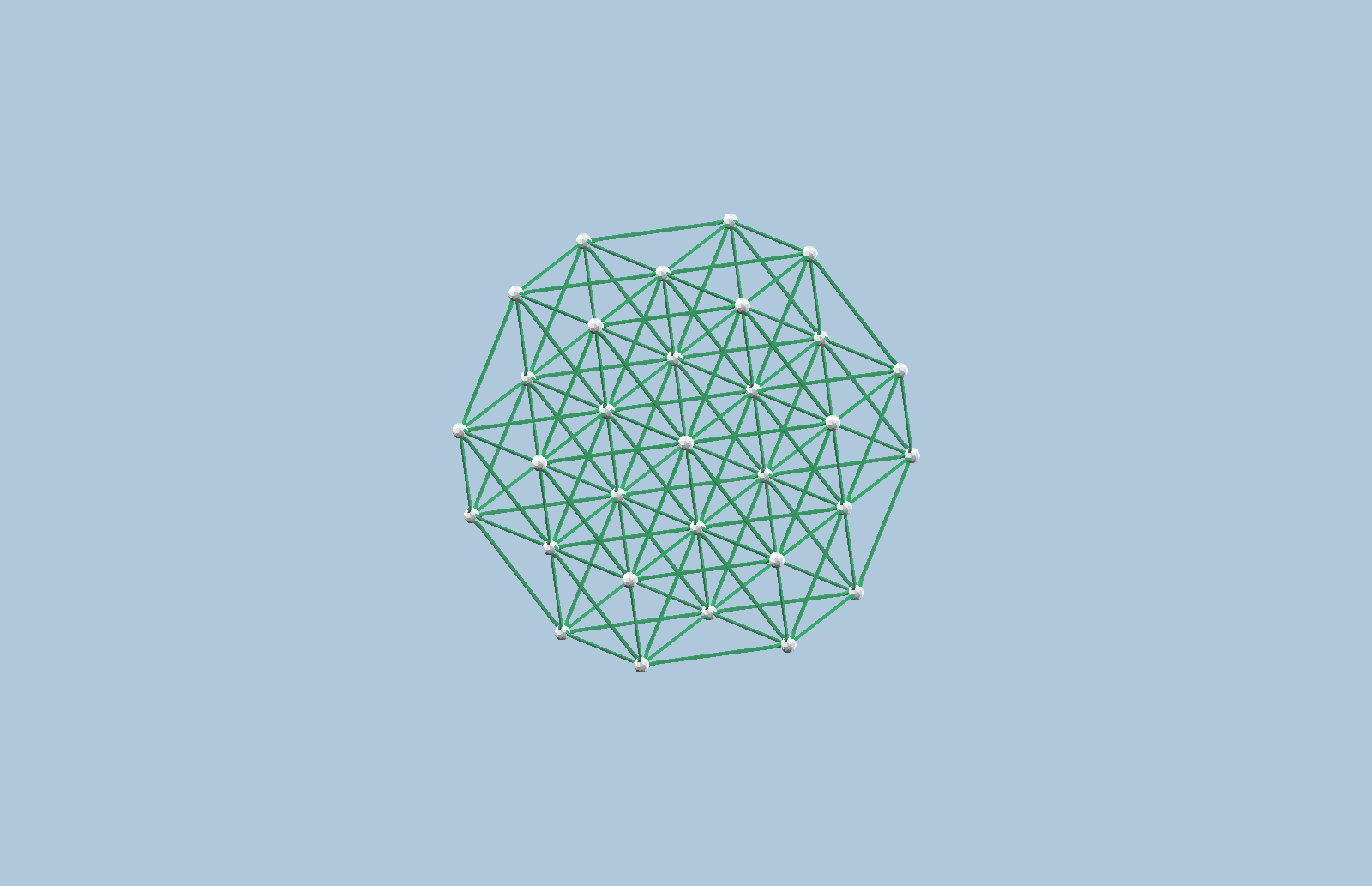
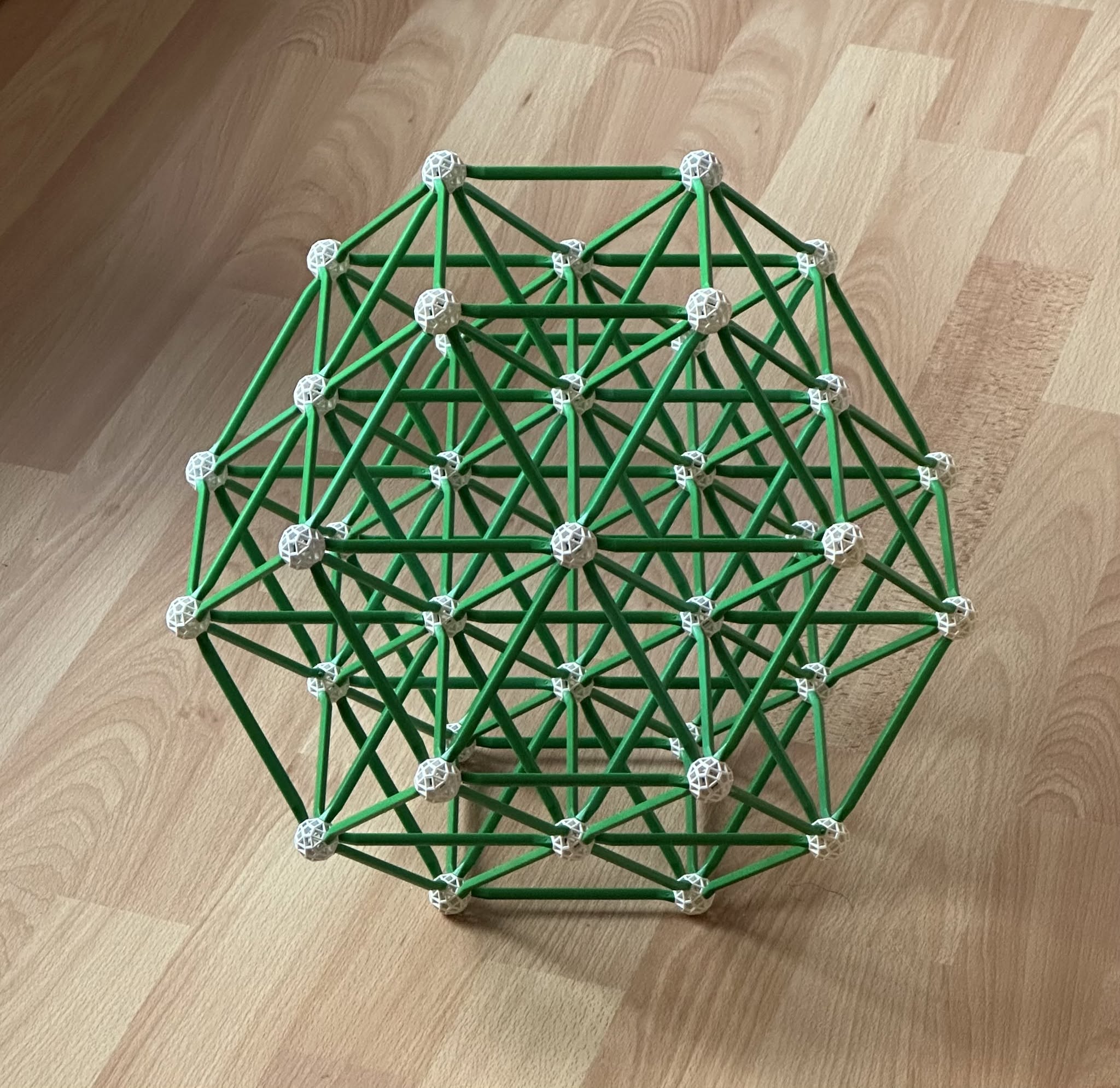
The 6-cube has infinitely many zomeable orthographic projections. The five models here are special because each one uses struts of a single color, and all struts in the model have the same abstract length.
Each model is determined by six equal-length projected cube-edge vectors forming a tight frame in 3D. Some projections identify multiple cube vertices or edges, so the visible model may be a collapsed projection of the abstract 6-cube.
| model | symmetry |
|---|---|
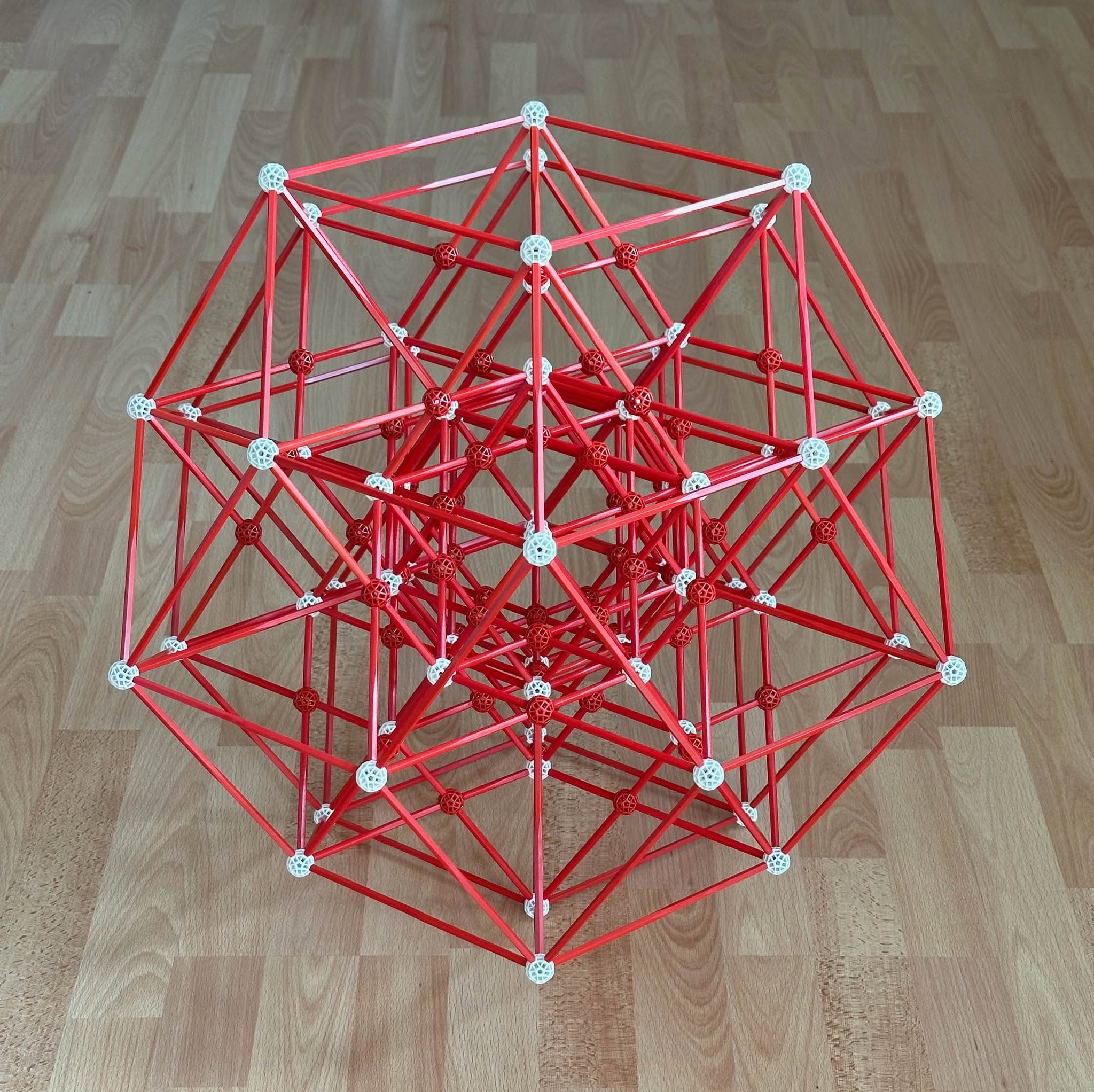
| red | H3 / Ih |
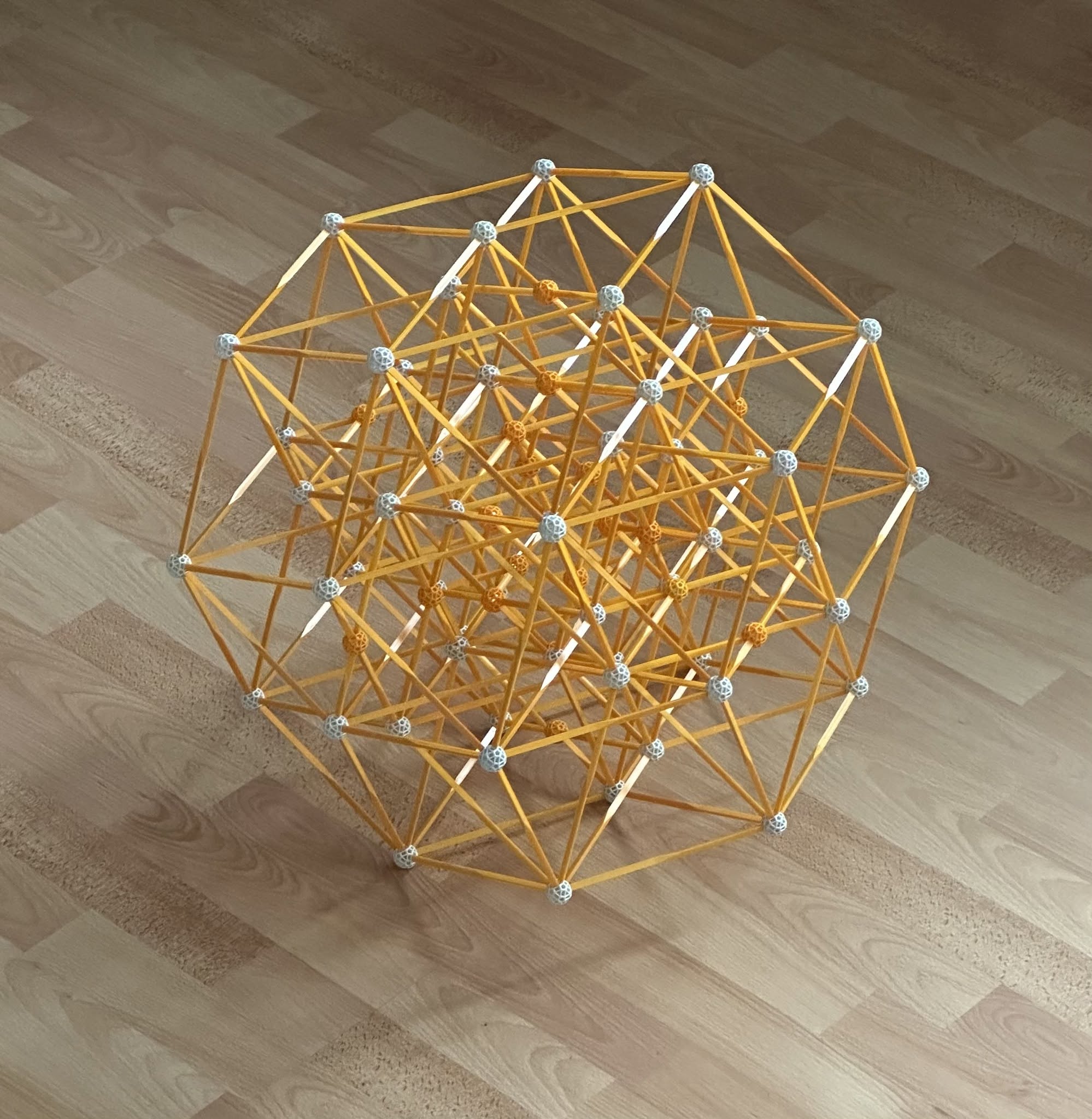
| yellow | Th |
| blue | D3d |
| green 1 | C3i |
| green 2 | Oh |
We treat these as abstract strut graphs and ignore strut crossings as if they impose no physical constraint. In a physical build, one might scale up the model and add balls at crossings, but that would change the equal-length property. On this page, the original projected 6-cube edges are the objects of interest.
We count only nondegenerate 6-cube projections, where the six projected coordinate directions are nonzero and distinct; lower-dimensional degeneracies are excluded. With this convention, these five models are the complete same-color, equal-strut classes.
The same tight-frame analysis also classifies other cube dimensions where same-color, equal-strut orthographic projections can occur. The entries below count symmetry classes of nonzero, distinct projected coordinate directions.
| cube dimension | red | yellow | blue | green |
|---|---|---|---|---|
| 3 | 1 | |||
| 4 | 1 | |||
| 6 | 1 | 1 | 1 | 2 |
| 9 | 1 | 1 | ||
| 10 | 1 | |||
| 12 | 1 | 12 | ||
| 15 | 1 | 2 | ||
| 18 | 12 | |||
| 21 | 1 | |||
| 24 | 2 | |||
| 30 | 1 |
The five models on this page are exactly the dimension-6 row of this table.
For more detail, see the supporting tight-frame analysis.
Physical constructions
Paulo Freire and I explored these projections with help from AI and vZome. Paulo built the red, yellow, and green 2 models below. Joris built the blue model.
These physical builds handle crossings that the virtual models leave unconstrained. Additional connectors and subdivided edges are construction adaptations; the equal-length property refers to the original projected 6-cube edges.
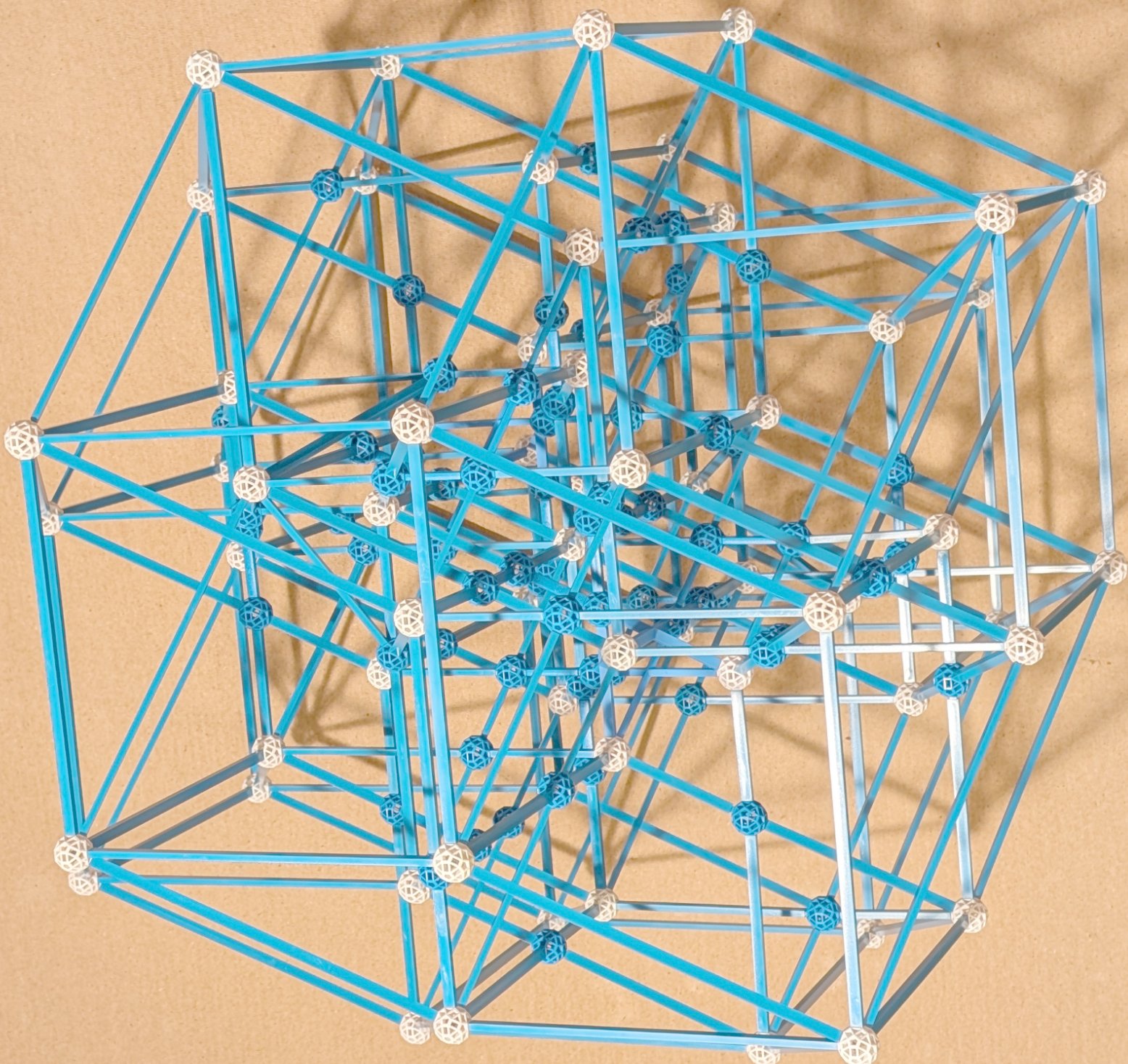
In Joris’s blue build, blue connectors mark added intersections and white connectors mark projected cube vertices. Six 3D-printed pieces handle the remaining crossings; his linked page gives the construction details.